Plate 01 — Bachelor's Thesis · TAMK · May 2026
Designing TIGORI: a mobile app to monitor and support motivation in youth team sports.
Case study: youth ice hockey
Adolescent athletes lose motivation quietly. Coaches notice the symptoms but rarely the cause. I designed, built, and pilot-tested a cross-platform mobile MVP that makes one-minute check-ins painless for players and gives coaches aggregated trends and gentle attention flags.
- Role
- Product discovery, user research, UX design, MVP development, pilot coordination and iteration
- Duration
- Oct 2025 — Apr 2026
- Output
- Full-stack MVP
- Stack
- React Native · TS · Node · MongoDB
- Pilot
- 8 players · 1 coach · 2 weeks
01 — Context
Why bother building anything at all?
In youth sports, drops in motivation, stress and overload increase the risk of burnout and dropping out if signs go unnoticed. Self-Determination Theory ties motivation tightly to how supported, capable and engaged a young athlete feels.
The problem is observability. A coach sees a tired or passive player and has to guess: is it sleep, school, loss of interest, or something at home? Adolescents in particular find it hard to talk about their inner state.
The reviewed products were primarily designed for adult or performance-focused environments. None of the reviewed solutions combined age-appropriate daily check-ins, coach attention flags, and lightweight gamification for youth team sports.
02 — Discovery
I started by asking — not by sketching.
Before a single screen was designed, I ran two online surveys: one with youth players and one with coaches. Participants were recruited through a partnering team and invitations sent to sports clubs across Finland. Guardian consent was collected for participants under 15, while participants aged 15–18 provided their own consent. Data collection was minimised, access was role-based, and research findings were reported in aggregated form.
32
Player responses
17
Coach responses
2
Survey instruments
6
Synthesised insights
Insight 01
Length kills participation
Players accepted daily updates only when they took under a minute. Anything longer was treated as homework.
Insight 02
Coaches don't want raw data
They asked for team-level trends and a small number of attention flags — not dashboards full of numbers.
Insight 03
Concrete indicators simplify self-reporting
Direct questions about emotions can be difficult or intrusive. Sleep, stress from school or home, and energy provided a more concrete structure for a short daily check-in.
Insight 04
Direct messaging dominates
78% reach the coach through WhatsApp/SMS today — the app must not feel like another inbox.
Insight 05
Engagement needed its own hypothesis
Lightweight avatar progression was introduced to make repeated check-ins more engaging without comparing players or turning wellbeing into a competition. Its long-term effect on retention still requires a larger pilot.
Insight 06
Minimal data is non-negotiable
Privacy policies are above the reading level of most teens. Collect as little as legally and ethically possible.
03 — Product
Six insights → six commitments.
- 01
A check-in must complete in under 60 seconds.
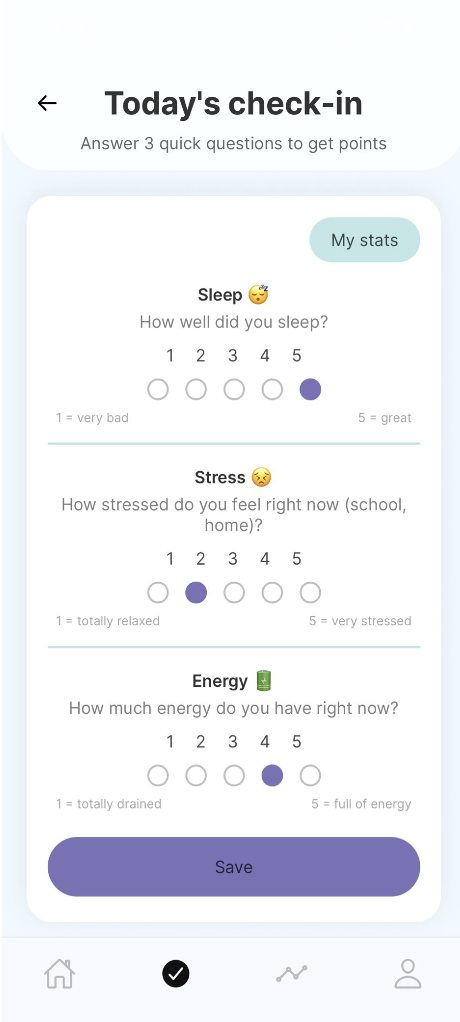
Three quick ratings: sleep, school or home-related stress, and energy. No free text required.
- 02
Coaches see trends, not rows.
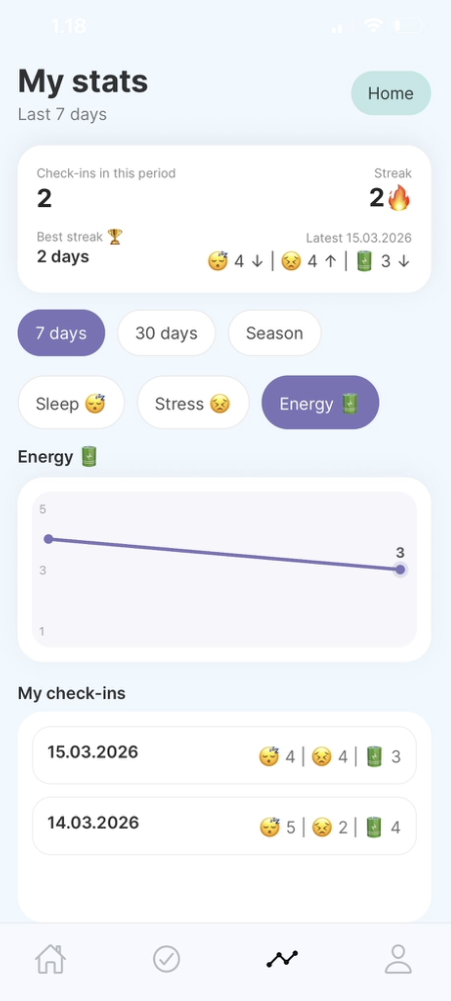
A clear team overview, individual player trends, and attention flags based on two consecutive days of high stress, low energy, or insufficient sleep.
- 03
Indirect language only.
The check-in uses concrete everyday indicators — sleep, stress from school or home, and energy — rather than asking players to label complex emotions.
- 04
Gamify the streak, not the score.
Avatar progression is daily-use linked, never compared between players.
- 05
No more accounts than necessary.
Lightweight auth, role-based access, minimal personal data.
- 06
Pilot in the wild before adding anything.
MVP scope is locked; expansion only after evidence.
04 — System
What I actually shipped.
Mobile client
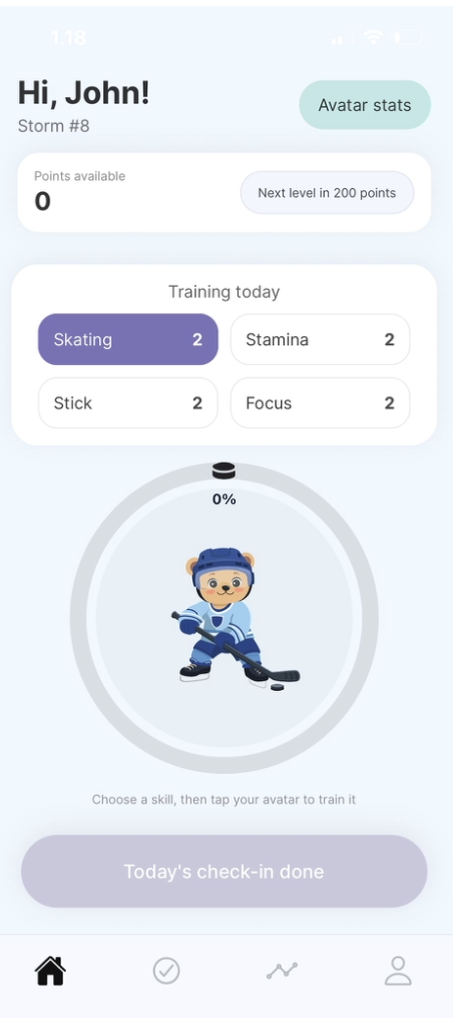
FrontendReact Native + TypeScript. Lottie for avatar animation. Two roles: player and coach.
Backend API
BackendNode.js service exposing REST endpoints, role-based access control, JWT auth.
Database
DataMongoDB with collections for users, teams, check-ins, avatar progress, insights.
Modules
ArchitectureAuth · Team mgmt · Check-ins · Insights · Avatar progress · Metrics & analytics.
Screens — Player & Coach
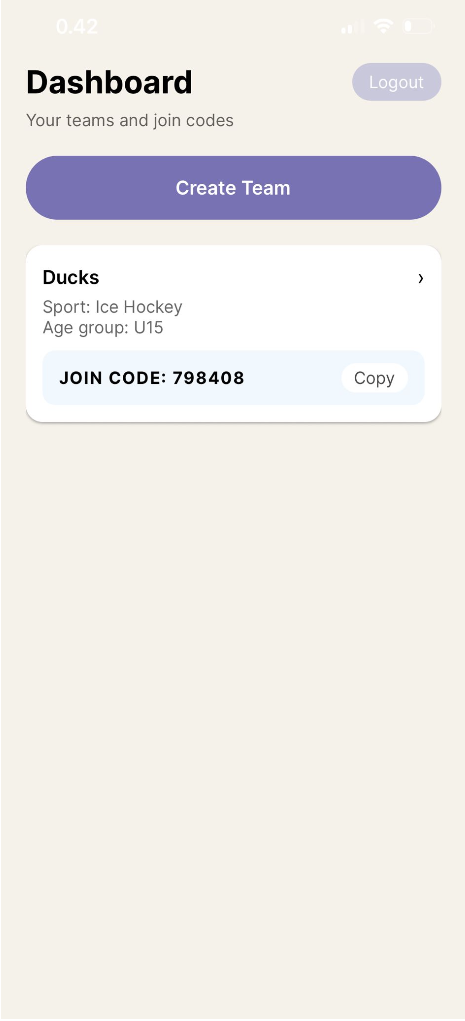
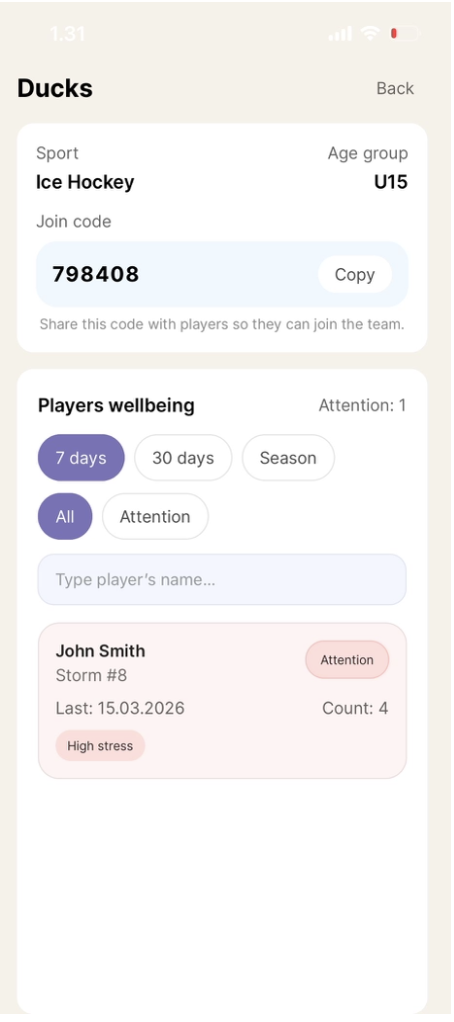
Beyond hockey
The MVP was piloted in ice hockey, but the core system is sport-adaptable — the check-in flow, avatar progression and coach-view logic can be reused across youth team sports, while the interface, colors, animations and character themes can be tailored to each sport.
05 — Pilot
One team. One short window.
I deployed the Android MVP with eight players and one coach from a youth ice-hockey team for a two-week pilot. Players completed 61 daily check-ins and used the avatar and personal statistics features, while the coach monitored team trends and attention flags.
The pilot demonstrated repeated use of the core check-in flow and provided early evidence that the coach view could support real-world awareness. The coach reported that the attention sorting helped identify a player who might need additional attention. However, the pilot was short and involved only one team, so the results should be treated as directional rather than conclusive.
8
Participating players
61
Completed check-ins
2 wks
Pilot duration
1
Participating coach
06 — Reflection
The real takeaways.
01
Never start with a screen. Start with a survey.
02
Constraints from users beat opinions from yourself.
03
Cut features to protect the one minute that matters.
04
Engineering is a force-multiplier in discovery, not a distraction.
05
Pilot honestly — small N is a clue, not a conclusion.
06
The best research artefact is the next better question.